

6 November 2019
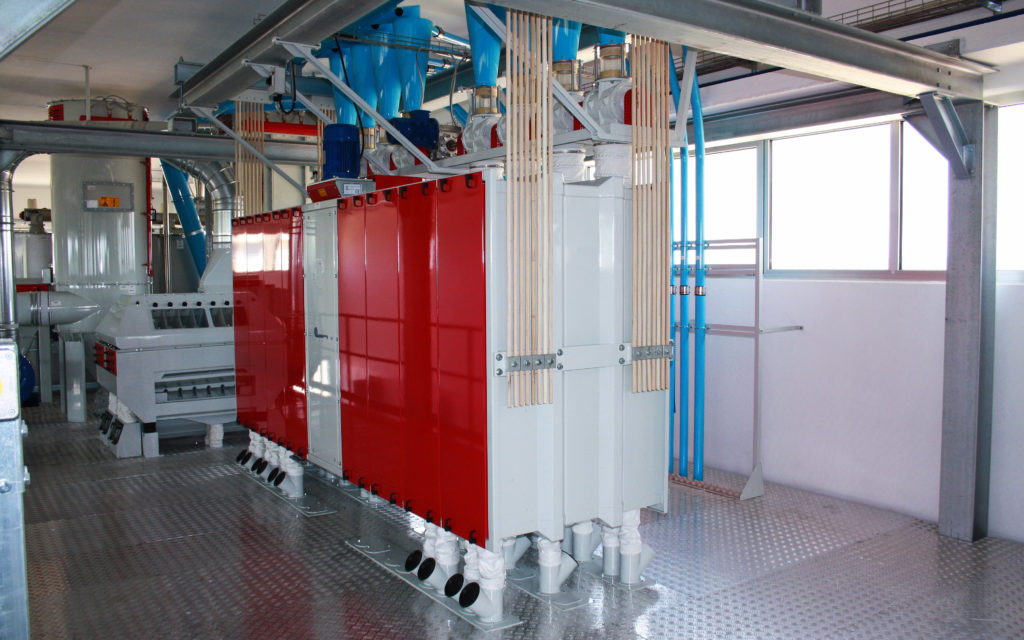
The article describes the machines that make up the mill, in particular the plansichter.
We have described the cleaning process (you can read about the cleaning here) and grinding the grain (you can read about the cylindrical grinding here and about the stone grinding here). Contrary to what one might think, flour does not come directly from the milling processes, but is obtained thanks to the screening and selection processes, which are carried out in the plansichter.
The history of the plansichter
The history of grinding began in the Egyptian era, with the first attempts to sift the products of grinding. So we can trace back to this time the birth of flour as well as the beginning of the history of plansichter.
The evolution of the plansichter continues in the Roman era, when they began to use rotating hexagonal sifter.
In the Middle Ages it was then switched to centrifugal sifter, consisting of an external rotating drum, a metallic net and a counter-rotating, to push the flour thanks to the centrifugal force.
In 1880 when the flat sifter was invented and in 1905 it was equipped with a free oscillation system. The new machine conceived is patented and called “plansichter”.

The characteristics of the plansichter
Let’s see the main components of a plansichter:
- Loading handles in flexible fabric for the loading of flour to be screened;
- Stacks, housed inside the channels contained in the steel case;
- Channels containing “parcels” of detachments consisting of overlapping sieves and frames;
- Insulated doors of the channels, to prevent condensation and limit noise;
- Suspension rods made of fibreglass, are connected to the case on one side, and to the ceiling on the other. They hold the machine suspended and are flanked by metal cables that hold the case in case of accidental breakage;
- Unloading handles made of flexible fabric that send the waste of the stacks to subsequent processing or to the flour silos.
The plansichter receives the milled products from the mills and selects the various fractions of these flour, through the stacks and the different veils:
- Rollermills receive the coarsest fractions for the subsequent grinding steps;
- Purifier receive the semolina and the semolina, of intermediate grain size;
- Bran finisher receive the cortical fractions, corresponding to the outer layers of the grain, for subsequent processing;
- Storage silos receive flour.
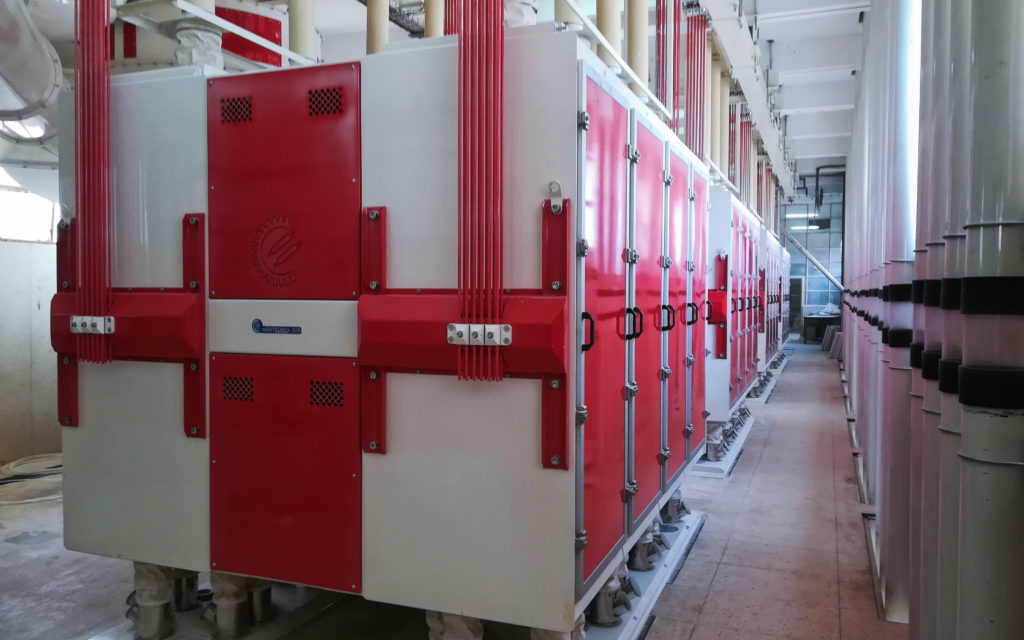
In order to carry out these tasks, the detachment is mounted on a frame that has the function of separating the two adjacent detachments and collecting the product passed through the top detachment. Ejectors send the unloaded fraction to subsequent processing, pushing the flours towards the chassis drains. The movement of the ejectors, and their particular shape, equipped with brushes or rungs, allows to keep clean the veils, which would otherwise lose effectiveness remaining clogged.
The first plansichter of Molitecnica Sud
As for the company reality of Molitecnica Sud, the first plansichter built in our factory dates back to 1989. Today we are able to design and build not only high quality plansichter entirely produced in Italy, but also complete plants and suitable for every need. To find out more about the mills click here.

Comments (02)